ART OF DARKNESS
EXPLORING THE ROLE OF DARKNESS IN URBAN CULTURAL HERITAGE
About the project
Art of Darkness investigates how darkness can contribute to the protection and appreciation of cultural heritage across Europe. By examining its cultural, aesthetic, and environmental significance, the project aligns with the New European Bauhaus ambition to shape a future that is more sustainable, inclusive, and beautiful.
The project brings together local partners from research, public institutions, lighting designers, and communities to develop and test new approaches to nighttime environments. Five pilots studies, located at cultural heritage sites in five European countries, serve as settings for exploring how darkness and lighting can coexist. Combining knowledge from architecture, lighting design, heritage conservation, environmental psychology, cultural anthropology, and engineering, the project seeks to create nighttime experiences that are aesthetically meaningful, environmentally responsible, and accepted by the communities who use these spaces. In doing so, it also highlights the contribution of darkness to human and ecological wellbeing and cultural innovation.
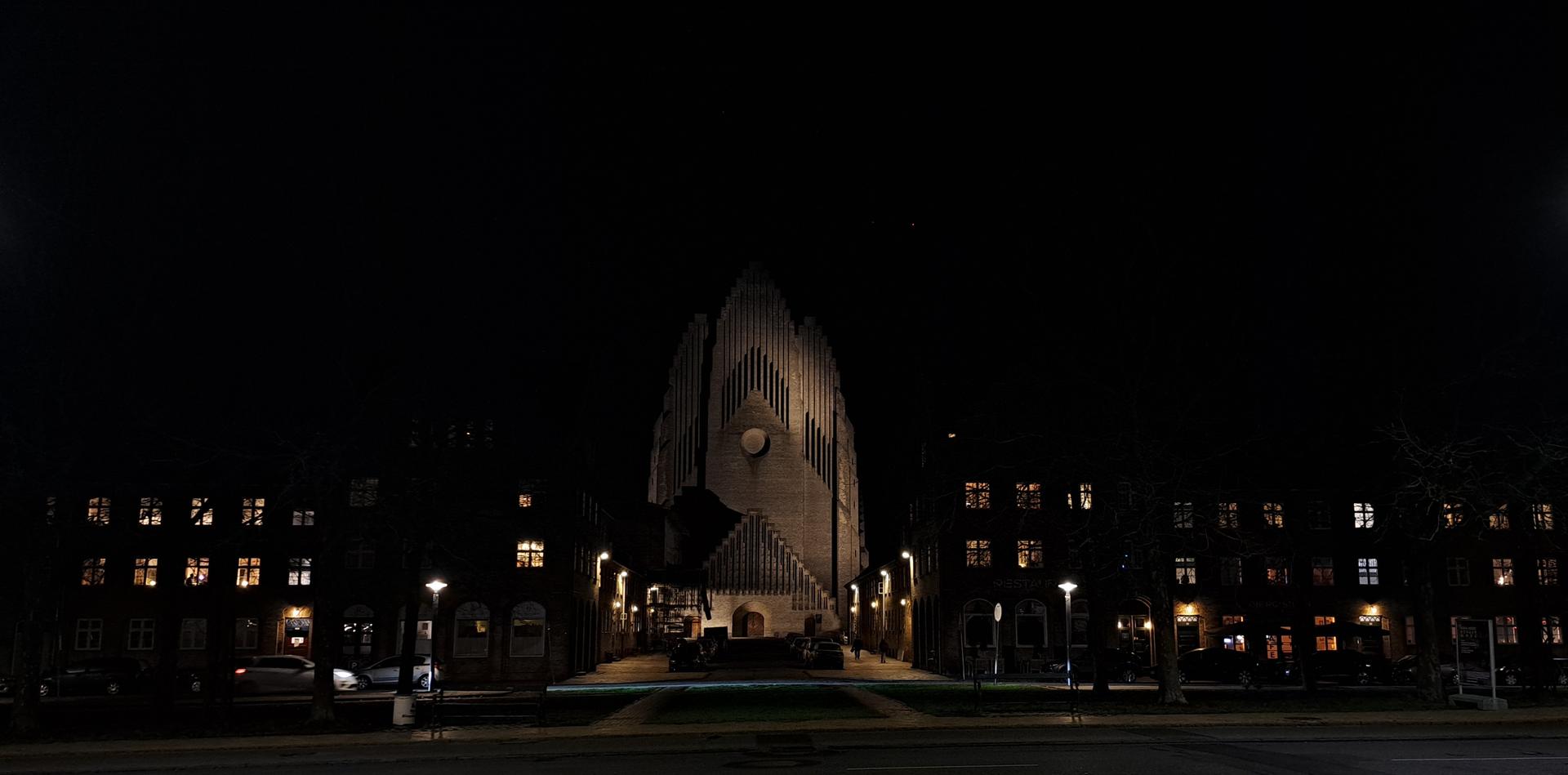
Copenhagen Pilot: Grundtvig’s Church and Bispebjerg square
Aalborg University (AAU) participates through its Lighting Design Lab, contributing research and design expertise to the Copenhagen pilot, centred on Grundtvig’s Church and Bispebjerg Square. Its work examines the relationship between people, place, and darkness using methods such as on-site measurements, spatial analysis, walking interviews, and visual documentation.
Pilot site goal
The Copenhagen pilot will explore new ways of shaping the nighttime character of Bispebjerg Square and its surroundings through a temporary lighting installation. The design will work with the interplay between light and darkness to reveal the area's distinct atmosphere after dark. The initiative ultimately aims to deepen people's engagement with the area's heritage and create a more meaningful experience of the urban environment at night.
Local collaborations
Community involvement is central to the Copenhagen pilot. The project builds on relationships established by Copenhagen Municipality through the Bispebjerg Bakke urban renewal initiative, alongside connections with residents, housing-area networks, and communities associated with Grundtvig’s Church. Cultural organisations will also take part, including Dansekapellet, a dance institution located in the former chapel at Bispebjerg Square. In parallel, lighting designers, manufacturers, and other industry specialists will be invited to contribute practical and technical expertise, helping connect the project's research and creative exploration with the development of viable lighting solutions.